
Graduate School of EngineeringCourse of Applied Chemistry and Bioscience
Applications are also open to international students.
In today’s world, there is a definite need for technologies that are inherently in harmony with the environment. More specifically, Japan, as the first among developed nations to face a rapidly aging society, is finding that knowledge of food and medicine, along with technological foundations, is becoming increasingly essential. In particular, key research areas include environmental harmony, resource efficiency, development of chemical processes based on energy-saving technologies, high-performance materials, electronics, biotechnology, new energy development, the search for performance in foodstuffs, and lifestyle disease prevention - all of which can be tackled through applied chemistry and bioscience. Our goal is to educate capable chemical engineers, bio engineers, and professionals in food and health fields, equipped with creative capabilities and a broad perspective to meet the social needs by developing the basic knowledge of subjects and applications.
This course is divided into two sections: Applied Chemistry and Bioscience. By imparting students with broad foundational knowledge in both fields, we bring them to the level where they can become highly skilled chemical engineers, biotechnology specialists, food and health experts, and more. Our graduates are also known for their broad perspective and high degree of creative capabilities.
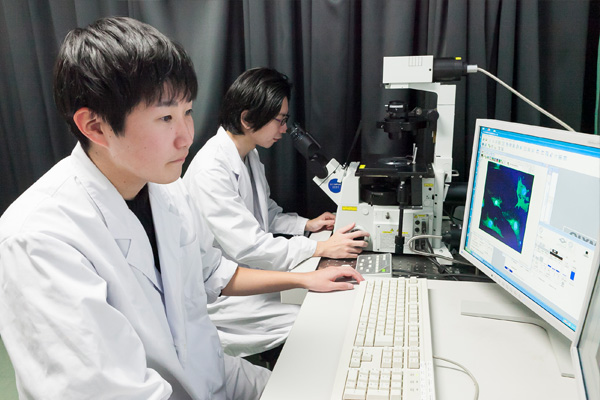
Applied Chemistry
Metallic oxidation points; plane defects and attributes; molecular design of high performance and high function polymer materials; synthesis; characterization; fixed catalyst preparation and application to chemical measurement; systems and measuring technologies for molecular recognition materials and applications to purification; the environment; biological impact of genotoxic agents in food; multiphase system apparatus flow and mass transfer rate; pollutant processing; structure of reaction intermediate by high resolution; spectroscopy; analysis of intermolecular motion, etc.
Bioscience
Environmental safety assessment of pollutants; flow and mass transfer of multiphase system reaction apparatus; bioprocess microbiological analysis of complex microbial systems; search for mucosal defense substances and function evaluation; analysis of structure and reaction of proteins; molecular design of high performance and high function polymer materials; synthesis; characterization; functional analysis of food substances: microbial control in food and the environment; function of food and evaluation of impact on health; impact of food on rheological properties and swallowing; formation of food substances and evaluation of metabolic disorders; dietary intake/circulatory dynamics and recognition, etc.